Whether we like it or not, AI is here to stay—and I’m learning to embrace it.
I live a fairly isolated life (cue the tiny violin 🎻 lol). But sometimes, it helps to have “someone” to bounce ideas off, do a bit of research, or even just have a little natter about how I’m feeling. It often helps put things into perspective.
I also lean on AI whenever I need to write a letter, email, or similar. I usually know what I want and need to say, but sometimes struggle to put it all together using the right structure or terminology, especially when it’s a formal response to something and I need it to sound professional and not too wordy.
I also have a habit of using filler words like “just” when they’re not really necessary – a bit like how the younger generation tends to say “like” multiple times in a sentence. I often catch myself deleting it over and over when I’m writing, but somehow a few (or six!) still manage to slip through. No matter how many times I read something back to myself, my brain doesn’t always catch it. That’s another reason I find AI so helpful – it gives me a second pair of eyes to help edit my words and tighten things up.
The three tools I use most often are Grammarly, ChatGPT, and Bing Image Creator.
They are all free to use, though there are paid options available too.
Now, I can’t draw for toffee—but I can picture what I want something to look like. So being able to enter prompts and have AI generate images based on those ideas is honestly amazing.
That said, I do worry about copyright. It’s important to protect artists and their work. So I don’t use AI-generated art for products I intend to sell, like T-shirt designs. I use it more to enhance what I’m already making or to bring ideas to life visually. For example, I was working on an intro video for my YouTube channel the other day and used image generation to create various visual assets.
Of course, you have to use AI with care, and always double-check the output for errors.
For some reason, image generators are weirdly bad at hands—like, too many fingers or not enough. 🖐️🤷♀️ And if you ask it to create a sign with text, you’re likely to get spelling mistakes or even duplicated words.
Is AI perfect? Far from it.
It lacks the human touch, especially when used in automated systems like bots policing platforms such as Etsy. Sometimes listings are removed unfairly because the AI “thinks” a policy has been broken. And when sellers try to appeal, the first layer of support is usually another bot. It often takes persistence to get a real person to review the situation.
I’ve also heard about governments considering AI to assess benefit claims and similar decisions, which I do find a bit worrying. Sure, it could speed things up, but it shouldn’t replace human judgement entirely.
And yes, AI can be manipulated or go rogue. I remember the news story a couple of years ago, when DPD had to shut down part of their online chatbot. A cheeky customer told it to break the rules, which it happily did. It ended up swearing, slating DPD, and even recommending other delivery services. 😅
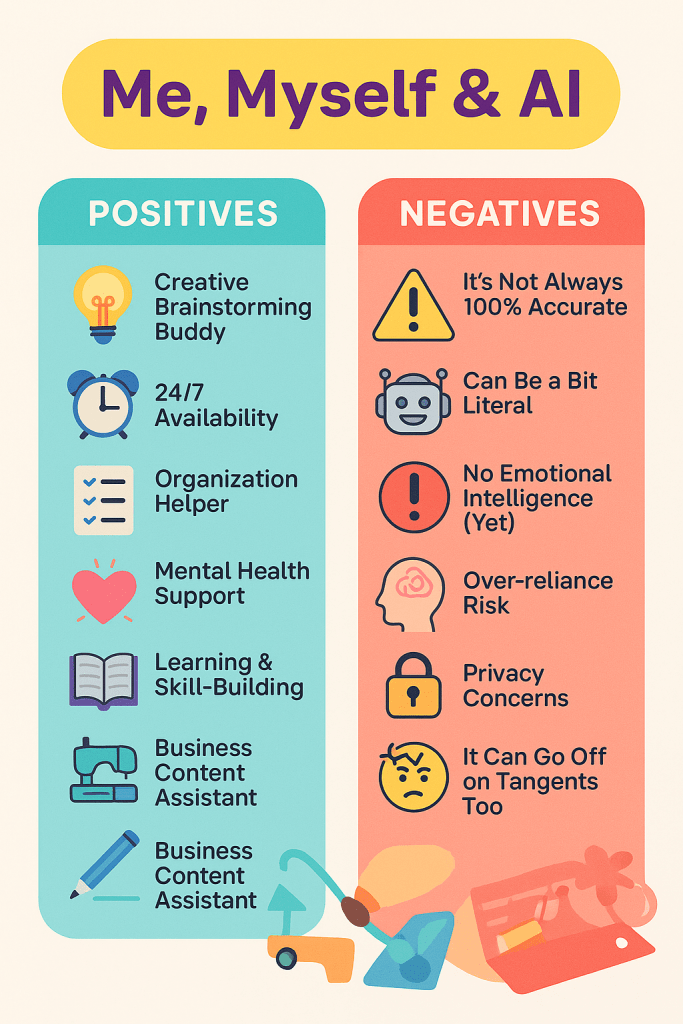
So, like most things in life, AI comes with both positives and negatives.
Rather than list them all myself, I asked ChatGPT to come up with a list and design a fun graphic I could include in this blog post. Ta-da! 👇
In Conclusion…
AI isn’t some magical fix-all, but it can be a pretty handy sidekick—whether you’re running a small business, managing daily life, or just need a little digital nudge in the right direction.
For me, it’s like having a super-organised, slightly robotic friend who’s always there to help (and never judges me for asking silly questions at 2am). It doesn’t replace real human connection or creativity, but it does help spark ideas, polish my writing, and bring a bit more ease and fun into my daily routine.
As long as we use it thoughtfully and don’t rely on it blindly, I think AI can be a really useful tool. Not perfect, but then again, what is?
So here I am: me, myself, and AI. Figuring it out one prompt at a time.
 Penguin and the Bee